Feeling Lost After Becoming a Parent? Understanding Matrescence and the Shift in Identity
You can love your child more than you ever imagined and still miss who you were before they were born. You can feel grateful, joyful, deeply connected to your baby, and completely overwhelmed by how much your life has changed. You can know that becoming a parent is something you wanted and still find yourself wondering, sometimes quietly and sometimes with real distress, Who am I now?
I hear versions of this question often. A parent may come to therapy because they are anxious or burned out, but underneath the anxiety is something harder to name. They miss their old freedom. They don't recognize their body. Their friendships have changed. Their relationship feels different. Their career doesn't feel the same. They can't remember the last time they did something simply because they wanted to. They love their child, but they also miss the person they were before becoming a parent.
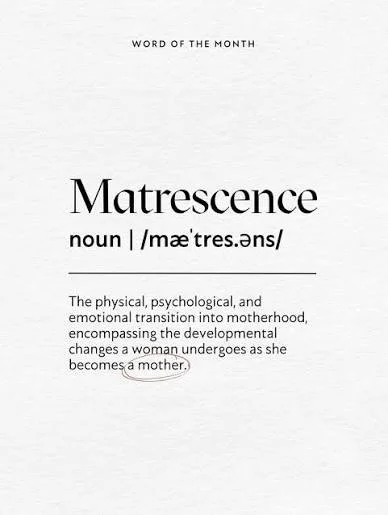
There is a word for this enormous transition that doesn't get nearly enough attention: matrescence.
What is matrescence?
Matrescence is the developmental process of becoming a mother. The term is often compared to adolescence because, in some important ways, the two transitions have a lot in common. Adolescence is a period when your body changes, your hormones shift, your relationships evolve, and you begin asking questions about who you are and who you're becoming. It can be exciting and painful, awkward and transformative, all at once.
Matrescence can be similar. Pregnancy, birth, and the postpartum period bring profound physical and emotional changes, but motherhood also changes your relationships, your priorities, your sense of time, your independence, and your understanding of yourself. You are getting to know a new person, your baby, while simultaneously getting to know a new version of yourself.
The difference is that most of us are prepared, at least to some degree, for adolescence. We expect teenagers to be moody, uncertain, self-conscious, and in the process of figuring themselves out. There is a developmental framework for what is happening. When you become a mother, however, there is often an expectation that you should simply be happy. You had the baby. You made it through pregnancy and birth. Now you should be enjoying motherhood.
But becoming a mother isn't a single moment. It is a process of becoming.
And that process can be beautiful, but it can also be incredibly disorienting.
“I don't feel like myself anymore.”
One of the most painful parts of early parenthood can be realizing that the person you were before is suddenly difficult to access.
Before having a baby, you may have had a strong sense of who you were. You had interests, friendships, a career, routines, sexuality, hobbies, ambitions, and the freedom to make decisions based largely on what you wanted. Maybe you traveled, went out to dinner, exercised, made art, read, worked late, slept in, or spent an entire Saturday doing absolutely nothing. Maybe you were spontaneous. Maybe you were very independent. Maybe your work was a huge part of your identity.
Then your baby arrives, and suddenly another person's needs organize nearly every part of your day.
Your body may look and feel different. Your relationship with your partner may change. Your friendships may shift. Your career may be interrupted or reimagined. Your relationship with sex and intimacy may change. Even something as simple as leaving the house can become a logistical undertaking.
And there is the mental load: remembering appointments, feeding schedules, childcare, clothing, supplies, milestones, meals, school forms, and all of the tiny details that keep a family functioning. So much of parenting requires being mentally available to someone else that it can become surprisingly difficult to hear your own thoughts.
Eventually, you may look around and think, Where did I go?
I think it is important to distinguish between losing yourself and losing access to yourself. You haven't necessarily disappeared. The parts of you that existed before motherhood are still there, but they may have been pushed into the background by the enormous demands of caring for someone else.
You may also discover that you don't actually want to return to exactly who you were before. Parenthood changes us. Some parts of your old identity may still feel essential. Other parts may no longer fit. You may develop new values, interests, boundaries, or priorities. The question isn't necessarily, “How do I get my old self back?” It may be, “Who am I now, and what parts of myself do I want to bring with me into this new life?”
The grief that can exist alongside love
There can be a particular kind of grief in becoming a parent that we don't talk about very much.
It isn't necessarily grief for your child. It can be grief for the life you had before your child existed.
You may miss being able to leave the house without packing a bag. You may miss your old body. You may miss having uninterrupted conversations with your partner. You may miss your friends. You may miss your career. You may miss sleeping. You may miss being spontaneous. You may even miss the version of yourself who had fewer responsibilities.
Sometimes parents feel guilty admitting these things because they interpret missing their old life as evidence that they don't appreciate their new one.
But love and grief can coexist.
You can be completely in love with your child and still miss parts of your life before parenthood. You can feel incredibly lucky and still feel resentful. You can want to spend time with your child and desperately want someone else to take over for a few hours. None of these feelings cancel out the others.
They are part of being human during a massive life transition.
When being needed becomes your entire identity
Another reason parents can feel disconnected from themselves is that parenthood can make being needed feel like a full-time identity.
There is always something that needs to be done. Someone needs a snack. Someone can't find their shoes. Someone is crying. Someone needs help regulating their emotions. Someone has an appointment. Someone needs you to remember something they themselves will absolutely forget.
For many mothers, there is also a disproportionate amount of invisible emotional and logistical labor. Even when a partner is sharing tasks, one parent may still be carrying the mental list of what needs to happen next.
When everyone else's needs are urgent, your own needs can start to feel optional.
You stop asking yourself what you want because there isn't much room for the answer. You become accustomed to organizing your day around everyone else. Eventually, the question “What do I want?” can feel surprisingly difficult to answer.
This is one reason that simply telling a struggling parent to practice more self-care can miss the point. Sometimes the issue isn't that you need another bubble bath or an hour to yourself. It is that you are trying to understand what happened to your sense of identity and autonomy.
Matrescence doesn't mean something is wrong with you
I think there can be something deeply reassuring about having language for this experience.
When you don't know about matrescence, it can be easy to interpret your feelings as a personal failure. You might think, Why am I struggling so much? Other people seem to be handling this better. I wanted this baby. Why don't I feel happier? Why do I feel so unlike myself?
Understanding matrescence doesn't make the hard parts disappear, but it can help take away some of the shame.
Of course, not every difficult postpartum experience is simply matrescence. Postpartum depression and anxiety are real and important mental health conditions, and symptoms such as persistent sadness, hopelessness, severe anxiety, loss of pleasure, frightening intrusive thoughts, or significant difficulty functioning deserve professional support. Matrescence and postpartum mental health conditions can also overlap.
But you don't have to be clinically depressed to struggle with becoming a parent.
Sometimes you are functioning. You are getting everyone where they need to go. You're doing the work. You're loving your child. From the outside, everything may look fine.
And still, something inside you is saying, I don't know who I am anymore.
That deserves attention, too.
Becoming yourself again, rather than going back
One of the most helpful shifts can be letting go of the expectation that you need to become your “old self” again.
You are not the same person you were before your child. That doesn't mean you've become less of yourself. It means you've changed.
The work may be figuring out which parts of your previous identity you genuinely miss, which parts you have outgrown, and which new parts of yourself are beginning to emerge.
Maybe you want to reconnect with your career, but with different boundaries. Maybe you realize you need more time with friends. Maybe you want to feel connected to your body again. Maybe you want to be creative. Maybe you miss traveling or going out or having long conversations with people who don't ask you to cut their food into smaller pieces. Maybe you simply need time in which no one needs anything from you.
These things aren't evidence that you love your child any less.
They are reminders that you are a whole person.
And your child doesn't need you to disappear in order to be a good parent.
In fact, part of what we model for our children is that relationships can coexist with individuality. We can love deeply without abandoning ourselves. We can care for other people while having needs of our own. We can change without losing every part of who we were.
There is a name for this transition
We never really expect to revisit adolescence, and yet in some ways, becoming a mother can bring us back to some of those same developmental questions. Your body changes. Your relationships change. Your priorities change. You may feel more vulnerable, uncertain, emotional, or unfamiliar to yourself than you expected. You are trying to figure out who you are while simultaneously caring for someone who depends on you completely.
It is a lot.
But there can be comfort in knowing that you are not the only person who has felt this way. There is a name for this transition. Matrescence gives us language for the complicated, nonlinear process of becoming a mother.
And perhaps having a name for it makes it a little easier to say:
This is hard.
I have changed.
I miss parts of who I was.
I love my child.
I don't know exactly who I'm becoming yet.
All of those things can be true at the same time.
You Don't Have to Figure It Out Alone
Sometimes, having the language for matrescence is the first step. The next is having somewhere you can actually talk about what this transition has been like for you.
Therapy can offer a space where you don't have to make your experience sound positive or manageable. You can talk about the parts of motherhood you love and the parts you struggle with. You can grieve what has changed, explore who you are becoming, work through anxiety or postpartum experiences, and begin to reconnect with the parts of yourself that have been pushed aside.
There doesn't have to be something dramatically wrong for therapy to be worthwhile. Sometimes you simply know that you don't want to keep feeling disconnected from yourself.
If you're in that place, I'd be happy to talk with you. You can start with a free 20-minute consultation to see whether working together feels like a good fit. From there, we can talk about what you're experiencing and what kind of support might be helpful.
Becoming a parent changes you. Therapy can be a place to make room for that change while making sure you still have a place in your own life.
